No products in the cart.
Return To Shop
Enjoy volume discounts
See
Free shipping on any of our orders


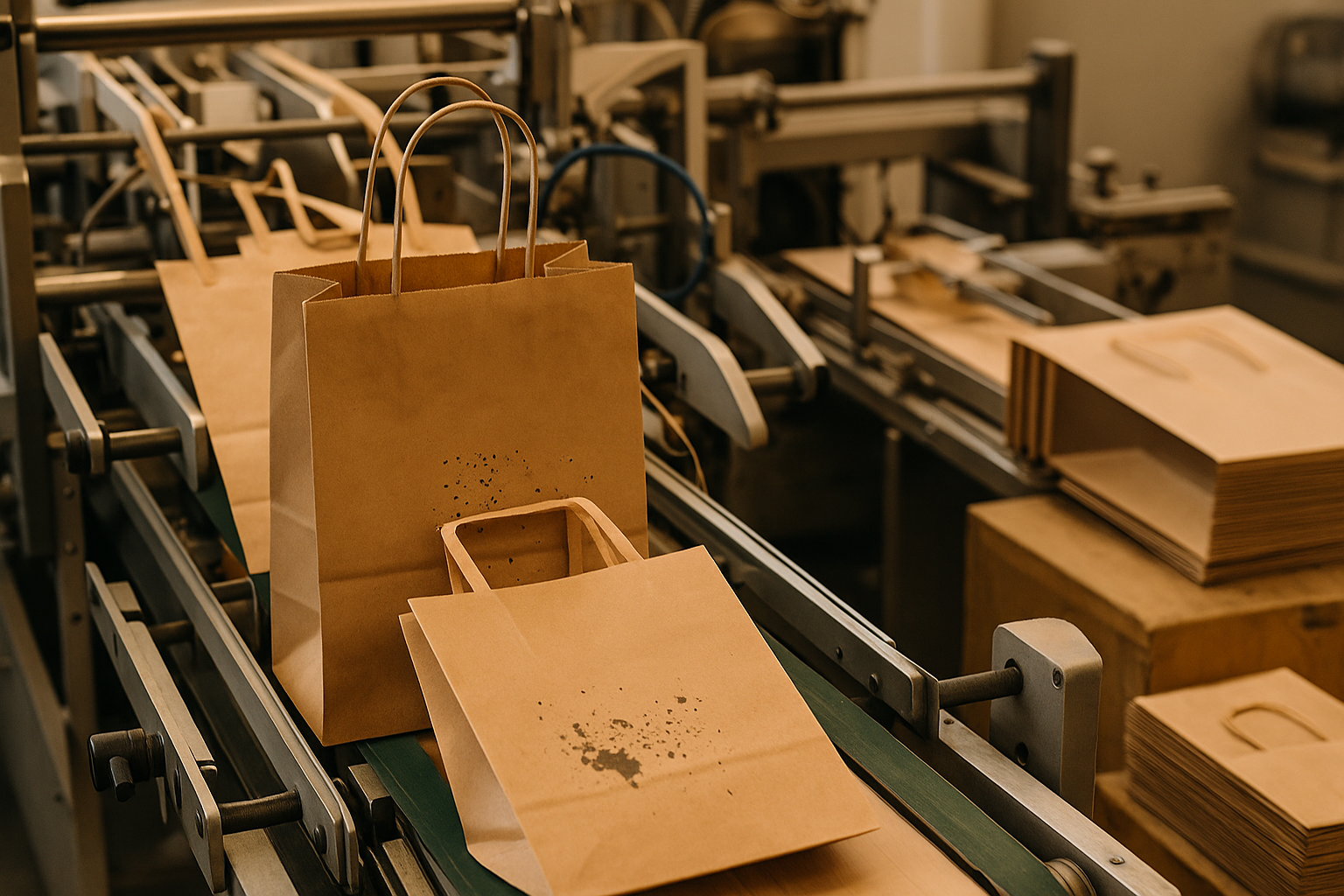
Paper bags are present in thousands of businesses, from neighborhood stores to large brands that are committed to more sustainable packaging. They are visual, functional and environmentally friendly. But behind each bag there is a technical and careful process that often goes unnoticed.
Where does the paper come from, what kind of machinery is used, how is it shaped, printed and made into a strong bag? In this article we tell you, step by step, how a paper bag is made from scratch, and why this process is key to ensuring quality and sustainability.
Raw material: vegetable fibers
It all starts with cellulose, a vegetable fiber obtained from responsibly cultivated trees such as pine or eucalyptus. These fibers can be virgin (first transformation) or recycled, and are the basis of kraft or white cellulose paper.
Once extracted, the pulp is processed to form the paper pulp. Here impurities such as lignin are removed and the texture is homogenized so that the quality of the paper is uniform.
Paper manufacturing
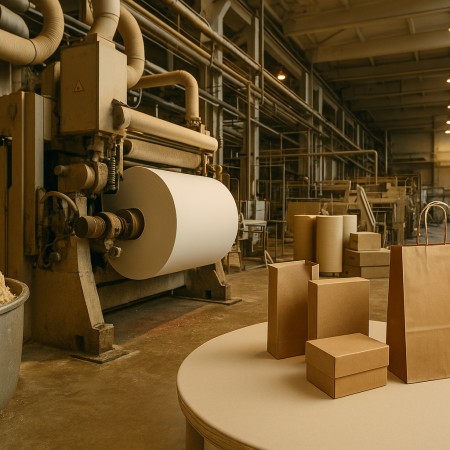
The resulting pulp is distributed on a large conveyor belt where it is pressed and dried to form sheets of paper. These sheets can have different thicknesses, finishes or treatments, depending on the type of bag to be manufactured.
This stage also defines whether the paper will be smooth, laid, recycled, FSC-certified, among others.
3. Cutting and folding
Once dry, the paper is wound onto large reels that are fed into die-cutting machines. These machines cut the paper according to the size and type of bag (horizontal, vertical, with gusset, with or without reinforced base...).
The folding is automated, precise and must ensure that the bag keeps its shape without breaking. Here, the areas of greatest tension are also reinforced, such as the base or the inside where the handles will go.
4. Handle application
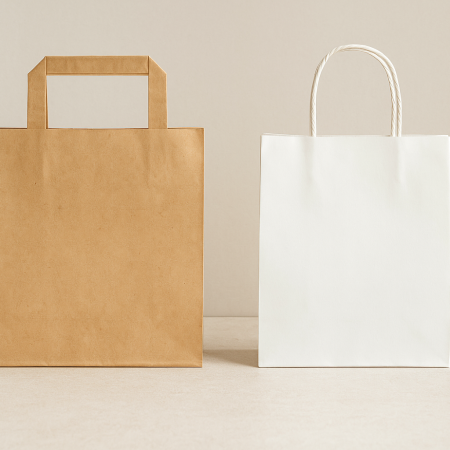
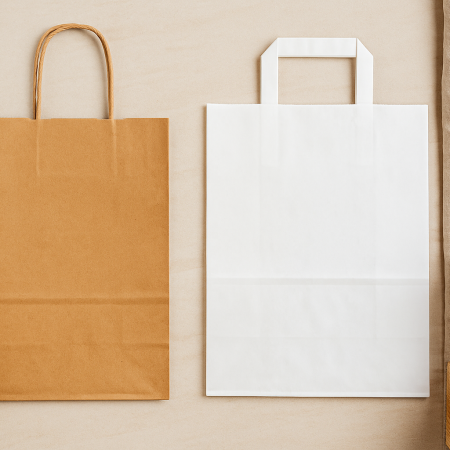
There are several types of handles (flat, twisted, die-cut), each requiring a different gluing system:
The flat handles are bent and fixed on the inside with reinforcement.
The twisted handles are coiled like a rope and glued at reinforced points.
The die-cut are cut directly in the upper area of the paper.
This step can also include an inner reinforcement if the bag is to carry weight.
5. Printing and personalization
Before or after assembly, many bags are customized with brand logos, text or artwork. The most common techniques are:
FlexographyPerfect for long runs and designs with few colors.
Silk-screen printingoffers more definition and is ideal for logos or sharp details.
Printing is usually done with ecological water-based or vegetable-based inks, so as not to compromise the sustainability of the final product.
6. Drying, quality control and packaging
Once printed and assembled, the bags go through a drying and quality control system. Cutting, gluing, alignment and printing are checked. Those that meet standards are folded and bundled into ready-to-ship packages.
Behind a paper bag is a technical process that combines advanced machinery with key decisions about design, materials and sustainability. Knowing how they are made helps to assess not only their function, but also their positive impact when responsible suppliers and certified materials are chosen.
The next time you deliver a product inside a kraft or cellulose bag, you will know that it is not a simple wrapping: it is the result of a more conscious production chain.


 English
  Spanish